
Introduction: Why Symbolism in Macbeth Matters
The symbolism in Macbeth is essential to understanding how William Shakespeare transforms a story about ambition and murder into a powerful exploration of human nature.
Written in the early seventeenth century, Macbeth uses recurring images of blood, darkness, sleep, unnatural weather, clothing, and supernatural visions to reveal the psychological and moral consequences of pursuing power without restraint.
These symbols do more than decorate the play:
they help audiences recognize Macbeth’s changing character, Lady Macbeth’s growing guilt, and the destruction that follows when personal ambition overwhelms moral responsibility.
Shakespeare’s tragedy remains relevant because its symbols communicate emotions and conflicts that audiences still recognize.
Blood can suggest guilt, darkness can conceal wrongdoing, and disturbed sleep can represent the loss of peace.
These meanings operate alongside the play’s historical context, including early modern beliefs about kingship, witchcraft, divine order, and the consequences of regicide.
Understanding these literary symbols makes Macbeth easier to interpret, whether you are studying Shakespeare for school, preparing an essay, teaching literature, or exploring the relationship between imagery and human psychology.
Featured-snippet definition: What is the symbolism in Macbeth?
Symbolism in Macbeth is Shakespeare’s use of objects, images, characters, and natural events to represent deeper ideas.
Blood symbolizes guilt and violence, darkness represents concealed evil, sleep suggests innocence and peace, and the witches embody uncertainty about fate and temptation.
Together, these symbols reveal how ambition and wrongdoing gradually destroy moral order and psychological stability.
What Does Symbolism Mean in Macbeth?
Symbolism in Macbeth refers to the literary technique through which a visible object, repeated image, or dramatic event communicates an idea beyond its literal meaning. Shakespeare uses symbolism to express emotions and moral conflicts that characters may struggle to understand or openly acknowledge.
For example, blood initially represents physical violence on the battlefield. After Macbeth murders King Duncan, however, blood becomes a reminder of guilt that cannot easily be removed. Its meaning develops as Macbeth and Lady Macbeth respond differently to their crimes.
This development is an important feature of Shakespeare’s dramatic technique. A symbol can change meaning as the plot progresses, revealing the difference between a character’s intentions and the consequences of their actions.
Three important principles help readers interpret these symbols:
- Context matters: An image can mean different things depending on when and how it appears.
- Symbols develop: Repeated images often gain additional meanings as characters change.
- Interpretations require evidence: A convincing reading connects the symbol to the play’s language, action, historical setting, and themes.
Rather than treating each symbol as an isolated code with one fixed answer, readers should examine how different images work together to develop Shakespeare’s central concerns.
Major Symbols in Macbeth and Their Meanings
Shakespeare builds the tragedy around several recurring symbols. Each one contributes to the play’s exploration of ambition, conscience, violence, deception, and the collapse of moral order.
| Symbol | Primary meaning | Literary significance |
| Blood | Guilt, murder, responsibility | Shows that violence leaves lasting psychological consequences |
| Darkness | Evil, secrecy, concealment | Creates an atmosphere in which wrongdoing can flourish |
| Sleep | Innocence, peace, restoration | Reveals the mental cost of committing murder |
| The witches | Temptation, uncertainty, fate | Complicate the relationship between prophecy and free will |
| The dagger | Ambition, temptation, inner conflict | Makes Macbeth’s murderous thoughts visible onstage |
| Clothing | False identity, illegitimate power | Suggests Macbeth is unfit for his newly acquired position |
| Weather and storms | Disorder, instability, disruption | Reflect the breakdown of political and natural order |
| Banquo’s ghost | Guilt, fear, consequences | Exposes Macbeth’s inability to control his conscience |
| The crown | Authority, ambition, insecurity | Distinguishes possessing power from deserving it |
| Birnam Wood | Prophecy, deception, unexpected change | Demonstrates the danger of interpreting predictions too literally |
These symbols overlap rather than operate independently. Blood connects to guilt, sleep, and hallucinations, while darkness connects to the witches, secrecy, and Macbeth’s desire to conceal his intentions. Their combined effect gives the play its psychological depth.
Folger Shakespeare Library
+1
1. Blood Symbolism in Macbeth: Guilt and Violence
Blood is one of the most powerful and persistent symbols in Macbeth. It begins as an ordinary consequence of warfare and becomes a lasting representation of murder, guilt, and moral responsibility.
How does blood symbolize guilt in Macbeth?
Before Macbeth kills Duncan, blood is associated with courage and military victory. Macbeth earns praise as a warrior who fights for Scotland. After he murders his king, however, blood acquires a different meaning: it becomes evidence of a crime that he cannot simply undo.
Following the murder, Macbeth imagines that the blood on his hands cannot be washed away even by the ocean. This exaggerated image transforms a physical stain into a moral problem. The size of the imagined stain suggests that his guilt feels greater than any ordinary act of cleaning could resolve.
Lady Macbeth initially takes the opposite position. She believes washing their hands will remove the visible evidence and dismisses the emotional consequences. Later, during her sleepwalking scene, she repeatedly attempts to wash imagined blood from her hands. Her behavior reveals how thoroughly the crime has affected her mind.
The contrast between the two characters is important: Macbeth immediately recognizes the enormity of what he has done, while Lady Macbeth initially attempts to minimize it. Eventually, both are overwhelmed by the consequences.
Literary significance: Blood shows that a crime may be concealed from other people without being erased from the conscience. It also links Macbeth’s first murder to the additional violence he commits to protect his crown.
2. Darkness Symbolism in Macbeth: Evil and Secrecy
Darkness in Macbeth symbolizes concealment, moral confusion, fear, and the desire to commit wrongdoing beyond the judgment of others. Shakespeare repeatedly places dangerous intentions and supernatural encounters in shadowy settings.
Macbeth wants the stars to hide their light so that they cannot witness his desires. This image reveals that he already understands the moral seriousness of his ambition. He does not merely fear being caught; he wishes to escape the scrutiny associated with goodness and truth.
Darkness also shapes the atmosphere of the play. The witches appear amid thunder, lightning, fog, and unpleasant weather. Later scenes of murder and fear continue this association between night and moral disorder.
However, darkness is not simply a synonym for evil in every context. It is especially significant because Macbeth actively seeks it as protection for his plans. The contrast between light and darkness dramatizes the difference between public appearances and hidden intentions.
Why is darkness important in Macbeth?
Darkness helps Shakespeare communicate Macbeth’s movement from respected nobleman to secretive tyrant. As his crimes increase, he increasingly relies on concealment, surveillance, and violence rather than trust or legitimate authority.
dlr Mill Theatre Dundrum South Dublin
+1
3. Sleep Symbolism in Macbeth: Innocence and Peace
Sleep symbolizes natural restoration, innocence, emotional security, and the peaceful condition Macbeth destroys when he murders Duncan.
Before the murder, sleep is an ordinary part of human life. Afterward, Macbeth imagines hearing a voice declare that he has murdered sleep itself. The moment suggests that his crime has damaged something fundamental within him.
Sleep matters because it represents a kind of peace that money, status, and political power cannot guarantee. Macbeth gains the crown but loses the ability to rest comfortably. He becomes increasingly anxious, suspicious, and fearful of the people around him.
Lady Macbeth’s sleepwalking later in the play develops the same symbolism. Her unconscious behavior exposes memories and guilt that she cannot successfully suppress while awake.
Example for a literature essay: Shakespeare uses sleep as a symbol of innocence to demonstrate the personal cost of immoral ambition. Macbeth can acquire royal authority, but he cannot recover the peace he sacrifices to obtain it.
The symbol remains relevant beyond the play because it illustrates a broader literary distinction between outward success and inward well-being. It does not establish that every person who experiences sleeplessness feels guilty; rather, Shakespeare uses sleep dramatically to reveal the specific consequences of the Macbeths’ actions.
4. The Witches in Macbeth: Fate, Temptation, and Deception
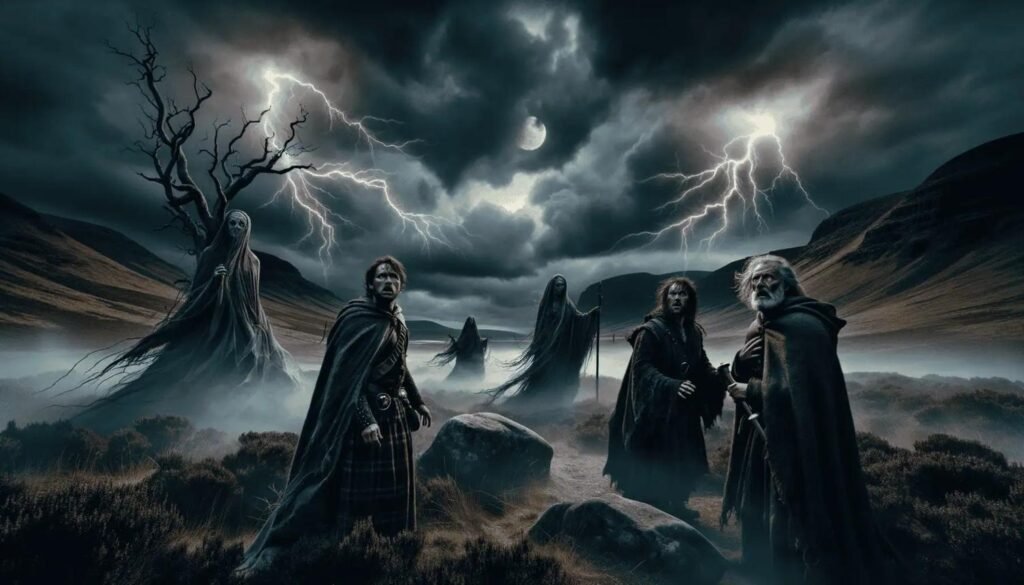
The three witches, also called the Weird Sisters, symbolize uncertainty, temptation, and the unsettling relationship between fate and personal choice.
Their famous declaration, “Fair is foul, and foul is fair,” establishes a world in which appearances cannot always be trusted. Good and evil become difficult to distinguish, and apparently reassuring predictions may conceal dangerous implications.
The witches predict that Macbeth will become king. Their words awaken an ambition that he subsequently chooses to act upon. This raises one of the play’s central philosophical questions: does Macbeth become a murderer because his future has been foretold, or because he freely chooses to pursue that future through violence?
Shakespeare does not provide a simple answer. The witches influence Macbeth, but they do not physically force him to kill Duncan. Their prophecies become dangerous partly because he interprets them in ways that support his desires.
Their later predictions give Macbeth a misleading sense of security. He believes that apparently impossible circumstances will protect him, only to discover that the language of prophecy is more complicated than he assumed.
Historical context of the witches
Witchcraft was a significant subject in early seventeenth-century England and Scotland. Shakespeare wrote Macbeth during the reign of James I, who had an established interest in witchcraft and its supposed relationship to treason. The play’s supernatural imagery would therefore have connected with concerns familiar to its original audience.
Folger Shakespeare Library
+1
Expert Tip: When analyzing the witches, distinguish between their predictions and Macbeth’s interpretations. This helps explain why the play explores both supernatural influence and personal responsibility.
5. The Dagger Symbolism in Macbeth: Ambition Made Visible
The imaginary dagger that appears before Duncan’s murder symbolizes Macbeth’s internal conflict, violent intention, and psychological instability.
In Act 2, Scene 1, Macbeth sees a dagger apparently suspended before him, pointing toward Duncan’s chamber. He questions whether it is real or merely a creation of his mind.
The dagger has a practical function in the plot: it directs Macbeth toward the place where he intends to commit murder. Symbolically, however, it externalizes a conflict that has so far existed primarily in his thoughts.
Its apparent transformation, including the imagined appearance of blood, connects the weapon to the consequences of the crime before Macbeth has actually committed it.
The dagger can therefore be interpreted in three related ways:
- Temptation: It appears to invite Macbeth toward the murder he is considering.
- Psychological conflict: His uncertainty about the dagger reflects his troubled state of mind.
- Foreshadowing: Its association with blood anticipates the violence and guilt that follow.
The scene is especially effective because the audience experiences uncertainty alongside Macbeth. Whether the dagger is supernatural or psychological, it reveals how completely his imagination has become occupied by murder.
6. Clothing Symbolism in Macbeth: Identity and Illegitimate Power
Clothing symbolizes rank, public identity, and the difference between appearing powerful and genuinely deserving authority.
After Macbeth becomes king, other characters use clothing imagery to suggest that his new position does not fit him naturally. His title is comparable to an oversized garment that has not been properly tailored to its wearer.
This image offers a concise explanation of Macbeth’s political predicament. He possesses the crown, but possession alone does not make him a legitimate or effective king.
Clothing imagery also connects to the play’s interest in deception. Just as a person can wear garments that do not fit, a ruler can display the outward signs of authority without possessing the moral qualities associated with good leadership.
Modern application: Clothing symbolism remains common in films, political satire, and visual storytelling. An ill-fitting uniform, borrowed crown, or exaggerated costume can suggest insecurity, imitation, or a mismatch between appearance and reality.
In Macbeth, the symbol reinforces the distinction between gaining power and being worthy of it.
7. Weather and Storms in Macbeth: A World Out of Balance
Thunder, lightning, darkness, and unnatural weather establish an atmosphere of instability and suggest that the murder of Duncan disrupts the natural and political order.
The play opens with a stormy encounter involving the witches. This opening prepares the audience for a world where ordinary expectations will be challenged. Later, reports of strange disturbances following Duncan’s death suggest that the crime has consequences beyond the royal household.
The symbolism becomes especially powerful within the play’s historical worldview. A king was often understood not merely as a political administrator but as part of a divinely sanctioned hierarchy. Killing a legitimate ruler could therefore be represented as an offense against a larger order.
Shakespeare dramatizes this idea through unusual events in nature, including reports of a predatory owl killing a falcon and other disturbances following the regicide. The reversal of expected relationships among creatures mirrors the reversal of political authority.
Folger Shakespeare Library
+1
The weather should not be treated as a scientific explanation of events. It is a theatrical and literary device through which Shakespeare communicates disorder, dread, and moral consequences.
8. Banquo’s Ghost: Guilt and the Return of the Past
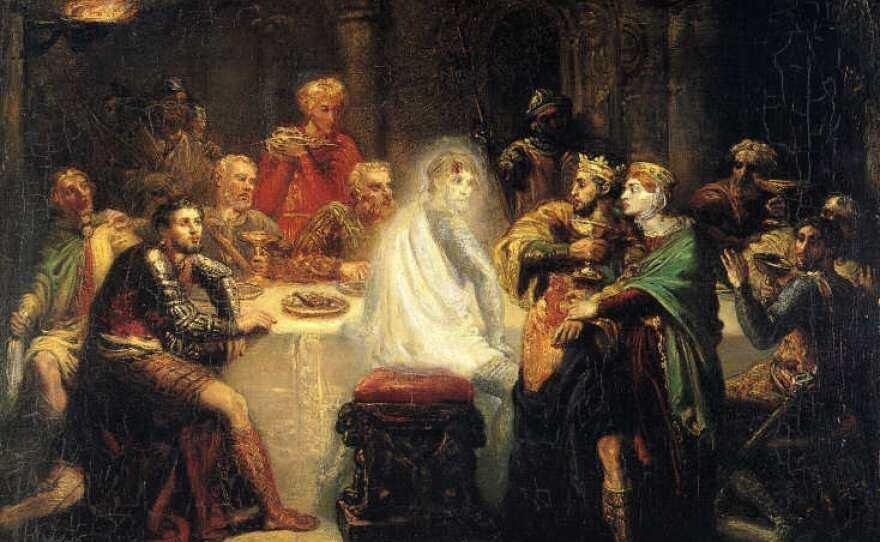
Banquo’s ghost symbolizes the psychological consequences of Macbeth’s violence and the return of a past he wants to suppress.
Macbeth arranges Banquo’s murder because he fears the witches’ prediction that Banquo’s descendants will inherit the throne. During a royal banquet, Macbeth sees Banquo’s ghost and reacts with visible terror.
The scene contrasts public authority with private instability. Macbeth is supposed to appear as a confident ruler, yet his behavior threatens to expose the insecurity beneath his royal image.
The ghost also connects to Macbeth’s growing isolation. Earlier, he could discuss his fears with Lady Macbeth. As the play progresses, the couple’s relationship deteriorates, and Macbeth becomes increasingly separated from the people who might otherwise support him.
An audience can interpret the ghost as a supernatural presence within the world of the play or as a theatrical expression of Macbeth’s disturbed conscience. Either way, its dramatic function is clear: the consequences of murder cannot be controlled as easily as Macbeth imagines.
9. The Crown: Ambition Without Security
The crown symbolizes kingship, political legitimacy, ambition, and the instability of power obtained through wrongdoing.
At first, becoming king appears to offer Macbeth the fulfillment of his desires. Yet the crown soon becomes a source of fear. He worries about rivals, fears Banquo’s descendants, and arranges further murders to protect his position.
This reversal exposes the difference between possessing power and feeling secure in it.
Macbeth’s authority depends increasingly on intimidation rather than loyalty. As his violence spreads, he loses the trust and support necessary to govern effectively.
The crown therefore represents a paradox: the object Macbeth believes will complete his life becomes the center of his anxiety. His pursuit of authority ultimately destroys the relationships and peace that might have made success meaningful.
10. Birnam Wood: Prophecy and the Limits of Certainty
Birnam Wood symbolizes the unexpected fulfillment of prophecy and the danger of confusing literal appearances with deeper possibilities.
The witches assure Macbeth that he will not be defeated until Birnam Wood comes to Dunsinane. He interprets the prediction as an assurance that his enemies cannot prevail because a forest cannot literally move toward his castle.
However, Malcolm’s soldiers use branches from Birnam Wood as camouflage while advancing toward Dunsinane. The prediction comes true in a way Macbeth did not anticipate.
This development connects directly to the witches’ earlier association with ambiguity and deception. Macbeth repeatedly mistakes a narrow interpretation of their words for reliable knowledge about the future.
Key interpretation: Birnam Wood symbolizes the limits of human certainty. Macbeth’s downfall is not simply caused by a prophecy but by his overconfidence in his own interpretation of it.
The episode also demonstrates Shakespeare’s skill in turning language into dramatic action: a seemingly impossible image becomes plausible through an unexpected military strategy.
Historical and Cultural Context of Symbolism in Macbeth
To understand Shakespeare’s symbolism fully, readers must consider the beliefs and political circumstances of his original audience.
Macbeth draws on Scottish history and the account of Macbeth found in Raphael Holinshed’s chronicles. Shakespeare reshaped historical material into a tragedy that explores treason, ambition, kingship, and supernatural temptation. The play was written during the reign of James I, when witchcraft and royal authority were subjects of considerable interest.
Folger Shakespeare Library
+1
The influence of kingship and the divine order
In early modern political thought, a legitimate monarch was frequently understood as occupying a divinely sanctioned position. Regicide could consequently be presented as more than a political crime: it represented a violation of the established hierarchy.
This context explains why the natural disturbances following Duncan’s murder carry such symbolic weight. Shakespeare’s stormy skies, unusual animal behavior, and disrupted sleep communicate the idea that Macbeth has damaged an order larger than himself.
Modern audiences may interpret these images differently. Some emphasize religious morality, while others focus on political legitimacy, psychological conflict, or the consequences of authoritarian rule.
The influence of witchcraft beliefs
The witches also reflect historical concerns about supernatural influence and treason. Their ambiguous predictions create dramatic tension because Macbeth wants certainty in a world where certainty is difficult to obtain.
The play does not need to be read as evidence that supernatural forces determine human behavior. Instead, the witches provide a framework for examining how fear, hope, and selective interpretation influence decisions.
Psychological Symbolism in Macbeth
The psychological dimension of Macbeth helps explain why its symbols remain compelling to contemporary readers.
Shakespeare uses imagined objects, recurring images, and changes in behavior to dramatize emotions that characters cannot easily manage. The dagger expresses Macbeth’s internal conflict; blood represents his awareness of wrongdoing; and sleepwalking reveals Lady Macbeth’s deteriorating control over her thoughts and actions.
These are literary representations, not clinical diagnoses. Their significance lies in how they make abstract emotions visible through theatrical action.
How Shakespeare connects symbols to the human mind
| Psychological theme | Symbolic expression | Meaning in the play |
| Anxiety | The imaginary dagger | Macbeth’s thoughts become difficult to separate from perception |
| Guilt | Bloodstained hands | Wrongdoing remains psychologically present |
| Fear | Banquo’s ghost | Macbeth cannot maintain his public composure |
| Loss of peace | Sleep and sleeplessness | Power fails to provide emotional security |
| Insecurity | Ill-fitting clothing imagery | Macbeth’s royal position does not fit his moral character |
| Despair | Images of emptiness and time | Macbeth increasingly questions the value of his achievements |
These connections help explain the play’s lasting appeal. Readers recognize the tension between public appearance and private experience, even when their lives differ greatly from Macbeth’s world.
Spiritual and Religious Interpretations of Macbeth
Religious and spiritual readings of Macbeth often focus on temptation, sin, conscience, judgment, and the consequences of violating moral obligations.
Blood can represent the burden of wrongdoing, while darkness evokes concealment and spiritual confusion. The witches may be understood as figures of temptation who encourage Macbeth to imagine a future without considering the moral cost of attaining it.
The play’s language also draws on a world in which heaven, hell, witchcraft, and divine judgment were meaningful concepts. These references contribute to the moral atmosphere surrounding Duncan’s murder.
However, spiritual interpretations should remain sensitive to historical and religious differences. Not every reader shares the same beliefs about supernatural forces or divine justice. A secular interpretation can examine the same imagery as a representation of conscience, responsibility, and the consequences of violence.
The most productive readings recognize the religious context without assuming that every audience must interpret the play in precisely the same way.
Symbolism in Macbeth Across Art, Film, and Modern Media
The symbols in Macbeth have influenced how directors, actors, artists, and educators present the tragedy.
Because the play relies on recognizable images, it can be adapted to different settings without losing its central conflicts. A modern production might use artificial lighting to emphasize darkness, red stage elements to evoke blood, or an empty throne to communicate political insecurity.

Theater and film
Lighting, costumes, sound, and stage design can make symbolic meanings immediately visible. A dark stage may emphasize secrecy, while an empty throne can suggest a crisis of authority.
Education and literary criticism
Students can trace recurring images across scenes to develop evidence-based interpretations. Comparing early and late appearances of blood or sleep helps reveal character development.

Visual communication and design
The crown, shadows, and contrasting colors can communicate power, danger, or deception in posters, book covers, and digital artwork. Their meaning depends on the surrounding visual and cultural context.
These applications illustrate a broader principle of semiotics: meaning emerges through the relationship between a sign, its context, and the audience interpreting it. A crown can symbolize legitimate authority in one setting and corrupt ambition in another.
Did You Know? Facts About Symbolism in Macbeth
- The play opens with the witches, not Macbeth. Their presence establishes an atmosphere of uncertainty before the protagonist’s ambition becomes the central concern.
- Blood changes meaning throughout the tragedy. It begins as an image of military violence and becomes closely associated with personal guilt and repeated murder.
- Prophecy does not remove Macbeth’s agency. The witches influence his thinking, but he chooses to pursue power through violence.
- Nature reflects political disorder. The unusual events following Duncan’s death connect the murder to a broader breakdown of order.
- The ending restores the throne but does not erase the tragedy. Malcolm’s accession represents political change, while the deaths and suffering remain part of Scotland’s history.
These points can help readers move beyond identifying symbols to explaining how Shakespeare develops them throughout the play.
Folger Shakespeare Library
+2
Myth vs. Fact: Common Misunderstandings
| Myth | Fact |
| Every symbol has only one meaning. | Symbolic meanings can overlap and develop as the play progresses. |
| The witches force Macbeth to murder Duncan. | Their prophecies influence him, but Macbeth makes his own decisions. |
| Blood only represents physical violence. | It also becomes a recurring image of guilt and moral responsibility. |
| Darkness is always evil in every literary context. | In this play, darkness often represents concealment and wrongdoing, but context matters. |
| Macbeth’s downfall is entirely predetermined. | The relationship between fate and free will remains deliberately complex. |
| Lady Macbeth never feels guilt. | Her later sleepwalking scene reveals the lasting psychological impact of the murder. |
Common Mistakes When Analyzing Symbolism in Macbeth
Avoid these mistakes when writing an essay or interpreting the play.
- Naming a symbol without explaining it. Do not simply write that blood symbolizes guilt. Explain how its meaning changes after Duncan’s murder.
- Ignoring the historical setting. The play’s treatment of kingship, witchcraft, and unnatural events reflects concerns relevant to its original audience.
- Treating interpretations as established facts. Support your analysis with scenes, language, and dramatic context.
- Confusing the witches’ predictions with Macbeth’s choices. Their influence matters, but so does his responsibility.
- Ignoring Lady Macbeth’s character development. Her changing relationship with blood and sleep provides an important contrast with Macbeth.
- Using quotations without analysis. A quotation becomes useful when you explain its imagery, context, and contribution to a theme.
Expert Tip: For a strong literary paragraph, identify the symbol, cite a relevant moment in the play, explain its immediate meaning, and then connect it to a broader theme such as ambition, guilt, or political legitimacy.
Practical Applications: How to Study Symbolism in Macbeth
Understanding symbolism becomes easier when you use a consistent method.
- Choose a recurring image. Start with blood, sleep, darkness, clothing, or natural disorder.
- Track where it appears. Record the act and scene, noting whether the symbol occurs before or after Duncan’s murder.
- Compare its changing meaning. Ask whether the image develops from something literal into a psychological, moral, or political symbol.
- Examine the character’s response. Macbeth’s fear, Lady Macbeth’s dismissal of guilt, and their later deterioration reveal different attitudes toward wrongdoing.
- Connect the image to a major theme. Explain how it contributes to the play’s exploration of ambition, conscience, fate, or authority.
- Support your conclusion with textual evidence. Refer to the relevant scene and use accurate quotations from your chosen edition.
This method works for school assignments, examination preparation, university-level literary analysis, and comparative essays about Shakespearean imagery.
Key Insights: What the Symbols Reveal About Macbeth
The symbols in Macbeth are most meaningful when considered together.
Blood reveals the consequences of violence. Darkness creates an environment of concealment. Sleep expresses the peace Macbeth destroys. The witches introduce uncertainty about fate, while the dagger dramatizes the struggle between intention and action. Clothing and the crown expose the gap between outward authority and genuine legitimacy. Finally, Banquo’s ghost and Birnam Wood reveal the consequences of Macbeth’s fear and overconfidence.
Together, these images form a connected system of literary meaning. They show that Macbeth’s pursuit of power changes not only his political position but also his relationships, perceptions, and understanding of himself.
Frequently Asked Questions About Symbolism in Macbeth
1. What is the most important symbol in Macbeth?
Blood is often considered one of the play’s most important symbols because it connects murder, guilt, violence, and responsibility. Its meaning develops from battlefield injury to the psychological burden of regicide. The recurring image of blood also links Macbeth and Lady Macbeth, revealing how differently they initially respond to the same crime.
2. What does blood symbolize in Macbeth?
Blood symbolizes physical violence and the lasting consequences of wrongdoing. Before Duncan’s murder, it is associated with Macbeth’s bravery in battle. After the murder, it becomes a reminder of guilt that cannot be removed simply by washing the hands. Lady Macbeth’s sleepwalking further develops this symbolism by revealing her inability to escape memories of the crime.
3. What do the witches symbolize in Macbeth?
The witches symbolize temptation, uncertainty, supernatural influence, and the complicated relationship between fate and free will. Their prophecies awaken Macbeth’s ambition and later give him a misleading sense of security. Their ambiguous language encourages him to trust interpretations that suit his desires, helping to expose the danger of confusing prediction with certainty.
4. How does darkness symbolize evil in Macbeth?
Darkness represents secrecy, concealed intentions, fear, and moral confusion. Macbeth wishes to hide his ambitions from the light, while the play’s night scenes and stormy atmosphere reinforce the connection between concealment and wrongdoing. Darkness also creates dramatic tension by separating what characters reveal publicly from what they intend privately.
5. What does sleep symbolize in Macbeth?
Sleep symbolizes innocence, peace, and natural restoration. After killing Duncan, Macbeth believes that he has destroyed sleep, expressing his fear that he can no longer enjoy the peace associated with an untroubled conscience. Lady Macbeth’s later sleepwalking shows how guilt continues to affect her even when she cannot consciously control her behavior.
6. How does Shakespeare use symbolism to develop the theme of ambition?
Shakespeare connects ambition with the dagger, the crown, darkness, blood, and clothing imagery. The dagger represents Macbeth’s movement toward murder, the crown represents his desired authority, and blood reveals the cost of obtaining it. Clothing imagery emphasizes that possessing a royal title does not automatically make Macbeth a legitimate or successful ruler. Together, these symbols demonstrate how unchecked ambition can undermine the very security it promises.
Conclusion: Why Symbolism in Macbeth Still Matters
The symbolism in Macbeth transforms a tragedy about a Scottish nobleman into a lasting exploration of ambition, guilt, temptation, and the misuse of power.
Shakespeare uses blood, darkness, sleep, the witches, the dagger, clothing, weather, Banquo’s ghost, the crown, and Birnam Wood to communicate ideas that extend beyond the immediate action of the play.
These symbols matter because they connect visible images with deeper psychological, political, and moral conflicts. They also reveal how meaning develops through repetition, context, and changing character relationships.
For modern readers, the play offers a practical lesson in interpreting literature and visual communication:
an image’s meaning depends on how it is used, what surrounds it, and how an audience understands it.
Whether examined through history, psychology, religion, education, or contemporary media, Shakespeare’s symbolism continues to demonstrate the power of imagery to express complex human experiences.
Key Takeaways
- Blood represents violence, guilt, and responsibility.
- Darkness suggests secrecy and moral confusion.
- Sleep symbolizes innocence, peace, and restoration.
- The witches complicate the relationship between fate and personal choice.
- The dagger dramatizes ambition and psychological conflict.
- Clothing and the crown expose the difference between appearance and legitimate authority.
- Weather and unnatural events reflect disorder in the play’s political and moral world.
- Banquo’s ghost represents the return of consequences Macbeth tries to suppress.
- Birnam Wood demonstrates the danger of overconfidence and narrow interpretations.
- The symbols work together to develop Shakespeare’s central themes rather than functioning as isolated images.
Semantic Entities, NLP Concepts, and Related Keywords
The article naturally covers the following entities and topic relationships for semantic relevance.
Primary keyword: symbolism in Macbeth
Related SEO keywords: Macbeth symbolism explained, symbols in Macbeth, blood symbolism in Macbeth, darkness in Macbeth, sleep symbolism in Macbeth, witches in Macbeth, dagger symbolism, clothing imagery in Macbeth, Birnam Wood symbolism, Banquo’s ghost, Macbeth literary analysis.
Major literary entities: William Shakespeare, Macbeth, Lady Macbeth, Banquo, King Duncan, Macduff, Malcolm, the Weird Sisters, Birnam Wood, Dunsinane.
Core themes: ambition, guilt, fate, free will, temptation, regicide, moral responsibility, political legitimacy, supernatural influence, psychological conflict, appearance versus reality, natural order.
Literary and NLP concepts: symbolism, imagery, motif, metaphor, foreshadowing, characterization, dramatic irony, semiotics, contextual meaning, semantic relationships, thematic development, historical context, intertextual analysis.
Topical relationships: blood and guilt; sleep and innocence; darkness and concealment; witches and prophecy; dagger and ambition; crown and political authority; clothing and identity; storms and disorder; ghosts and conscience; Birnam Wood and deceptive certainty.
These related concepts provide a foundation for connecting this article with broader literature, Shakespeare, tragedy, literary devices, and symbolism topic clusters on your website.

Learn about religious symbolism, cultural icons, and historical meanings with William Carter.
