
Introduction: Why Willow Symbolism Matters
Willow symbolism has fascinated people for centuries because the willow tree combines graceful beauty with remarkable flexibility.
Its long, flowing branches bend in the wind, its roots often thrive near water, and its appearance changes with the seasons.
These qualities have made the willow a powerful symbol of resilience, emotional depth, healing, renewal, and the ability to adapt to life’s challenges.
Across different cultures, the willow tree has represented both sorrow and hope.
Its drooping branches can evoke mourning, remembrance, and unspoken emotions, while its capacity to grow in damp environments and regenerate from cuttings suggests persistence and new beginnings.
In folklore, poetry, spirituality, and visual art, the willow frequently bridges the natural world and human experience.
Understanding willow symbolism is useful because symbols shape how people communicate feelings, interpret stories, design meaningful spaces, and express cultural identities.
A willow tree in a poem may represent heartbreak, while the same tree in a garden may communicate peace, protection, or a connection with nature. Its meaning depends on context, tradition, and personal experience.
What does willow symbolism mean?
Willow symbolism refers to the meanings associated with the willow tree, especially resilience, flexibility, healing, grief, renewal, and emotional wisdom. Its bending branches suggest the ability to adapt without breaking, while its association with water connects it to intuition and emotional life. Depending on the cultural or artistic context, the willow may represent both sorrow and hope.
The willow’s symbolism is not fixed or universal. Some traditions emphasize its association with mourning, while others connect it with vitality, fertility, spiritual protection, or renewal. Exploring these interpretations reveals why this familiar tree continues to carry such rich meaning in modern life.
1. The Core Meanings of Willow Symbolism
The willow tree represents several interconnected ideas, from emotional sensitivity to personal strength. Its appearance and growth patterns provide natural starting points for understanding why people have assigned it so many meanings.


9
Resilience and Inner Strength
One of the most important meanings of willow symbolism is resilience. Willow branches can bend considerably under wind and rain, creating an image of strength expressed through flexibility rather than resistance.
This quality offers a useful metaphor for human life. Resilience does not always mean remaining unaffected by difficulty. Sometimes it means acknowledging pain, adjusting to changing circumstances, and continuing forward without losing one’s sense of self.
A willow tree can therefore symbolize:
- Recovering from disappointment or personal loss.
- Adapting to changes in relationships, work, or identity.
- Remaining hopeful during uncertain periods.
- Finding strength through patience rather than confrontation.
Practical example: A willow tree in a painting displayed in a counseling room might communicate emotional recovery and the possibility of growth after hardship.
Flexibility and Adaptability
Willow branches often sway and bend rather than remain rigid. This makes the tree a natural symbol of adaptability, open-mindedness, and the ability to respond to changing circumstances.
In philosophy and personal development, the willow can represent a balanced approach to life: maintaining core values while remaining willing to change strategies, perspectives, or expectations.
Its message is not that people should accept every situation passively. Instead, it suggests that flexibility can be a form of strength.
Grief, Mourning, and Remembrance
The weeping willow, with its long branches hanging toward the ground, is especially associated with sorrow and mourning in Western visual culture.
Its downward-reaching foliage can resemble a posture of sadness, while its quiet presence beside water evokes reflection and remembrance. Willow imagery has consequently appeared in mourning art, memorial landscapes, and poetry about loss.
However, the willow’s association with grief does not necessarily make it a symbol of despair. It can also represent the continuing presence of love, the process of remembering someone, and the gradual movement toward acceptance.
Healing and Renewal
Willows are associated with healing for both historical and botanical reasons. Willow bark contains salicin, a compound related to the development of salicylate medicines, including aspirin. This medicinal history has contributed to the tree’s association with relief and recovery.
Its capacity to grow under suitable conditions and regenerate from cuttings also makes it an evocative symbol of renewal.
It is important to distinguish these ideas: the tree’s medicinal history is a matter of botanical and pharmaceutical evidence, while the belief that a willow represents emotional or spiritual healing is a symbolic interpretation.
Wisdom, Patience, and Emotional Awareness
Willows frequently grow in landscapes that encourage quiet observation, such as riverbanks, wetlands, and lakeshores. Their graceful form and long life in favorable conditions can suggest maturity, patience, and thoughtful reflection.
In this sense, willow symbolism encourages people to listen before reacting, recognize complicated emotions, and understand that personal growth often requires time.
2. Historical Origins and Evolution of Willow Symbolism
The willow has a long relationship with human communities because willow species grow across many parts of the world and have practical uses beyond their ornamental beauty.
Ancient Uses and Early Associations
People have used willow wood and branches for baskets, fences, tools, and other practical objects. Some willow species have also been used in traditional remedies.
These everyday relationships help explain how the tree became associated with usefulness, resourcefulness, and healing. However, the precise symbolic meaning of willow varied by location, species, and historical period; there was no single ancient interpretation shared by every society.
In regions where willows grew beside rivers, streams, and wetlands, their appearance also connected them visually with water, fertility, seasonal change, and the rhythms of nature.
Willow Symbolism in Classical Traditions
In ancient Mediterranean cultures, trees and plants often carried associations with particular deities, landscapes, and aspects of human life. Willow-related traditions sometimes connected the tree with water, fertility, or feminine imagery.
Such associations should be interpreted carefully. Classical mythology contains numerous plant transformations and sacred trees, but not every story involving a tree refers specifically to the willow. The meaning of an individual myth must be established from its own historical sources rather than assumed from modern symbolism lists.
Medieval and Early Modern Interpretations
During medieval and early modern periods in Europe, plants became meaningful features of religious art, medicinal writing, folklore, and literature.
Willows growing near waterways could contribute to images of solitude, contemplation, and the passage of time. In later European artistic traditions, the weeping willow became particularly recognizable as an emblem of mourning.
By the eighteenth and nineteenth centuries, weeping willows were widely used as ornamental trees in gardens, parks, cemeteries, and memorial landscapes. Their visual form made them especially effective for expressing sadness and remembrance without words.
The Willow in Modern Culture
Today, willow symbolism appears in environmental design, literature, wellness imagery, tattoos, jewelry, brand identities, and digital illustrations.
The tree may communicate resilience in a personal-growth context, peacefulness in a spa or garden setting, or grief in a memorial design. Modern meanings often combine older cultural associations with individual interpretations.
The continuity is striking: people still use the willow’s visible qualities to express ideas that are difficult to describe directly.
3. Willow Symbolism Across Different Cultures
Willow symbolism varies considerably across cultures. Similar physical features may inspire different meanings depending on religious traditions, folklore, literature, and relationships with the natural environment.



10
Chinese Cultural Traditions
In Chinese cultural imagery, willow branches can be associated with spring, graceful beauty, separation, and the emotions surrounding departure. Willow imagery appears in poetry and visual traditions, where a tree or branch can help evoke a landscape of longing or farewell.
The willow is also associated in some Chinese traditions with warding off harmful influences. Particular meanings depend on the practice and historical setting, so these associations should not be treated as universal beliefs held by all Chinese communities.
In literary contexts, the willow’s flexibility and delicate appearance can suggest elegance and tenderness. Its relationship with parting can also make it a fitting image for the emotional experience of leaving a familiar place or person.
Japanese Cultural Interpretations
In Japanese art and literature, willows can evoke grace, water, seasonal atmosphere, and quiet reflection. Their delicate branches suit visual traditions that emphasize the changing appearance of nature and the emotional qualities of a landscape.
Willows also appear in Japanese ghost stories and supernatural imagery, including traditions in which particular trees or waterside settings are associated with mysterious encounters. These stories do not establish that every willow is considered supernatural; rather, they show how familiar natural settings can acquire imaginative and cultural significance.
Celtic and Broader European Folklore
In some modern interpretations of Celtic symbolism, the willow is connected with intuition, poetic inspiration, femininity, and lunar imagery. Willows are also linked to water and seasonal cycles in contemporary spiritual writing.
These meanings require historical caution. Modern accounts sometimes present a unified ancient Celtic willow tradition without sufficient evidence. It is more accurate to distinguish documented folklore and historical practices from contemporary reconstructions or spiritual interpretations.
Across broader European culture, the weeping willow is particularly associated with mourning, romantic melancholy, and remembrance. Its presence in cemetery landscapes and memorial art reinforces these associations.
Indigenous Traditions
Willow species have practical, medicinal, and cultural importance in a number of Indigenous communities around the world. Uses vary by species and place and may include basketry, construction, tools, and traditional healing practices.
The cultural meaning of willow cannot responsibly be reduced to one universal Indigenous interpretation. Specific teachings may be community-specific, and some knowledge is best understood through sources shared by the communities themselves.
A respectful discussion recognizes that practical knowledge, cultural identity, and spiritual meaning may be closely connected without assuming that every community assigns the tree the same symbolism.
Comparative Overview
| Cultural context | Possible willow associations | Important qualification |
| Chinese traditions | Spring, grace, farewell, and protection in some contexts | Meanings vary by historical period and practice |
| Japanese art and folklore | Natural beauty, water, atmosphere, and supernatural storytelling | Not every willow image has a spiritual meaning |
| European memorial culture | Mourning, grief, remembrance, and melancholy | Especially prominent in later Western visual culture |
| Some contemporary Celtic-inspired spirituality | Intuition, femininity, lunar imagery, and creativity | Many popular associations are modern interpretations |
| Indigenous communities | Practical knowledge, traditional uses, and community-specific cultural meaning | Interpretations must be grounded in particular peoples and places |
The main lesson is that willow symbolism is culturally shaped. Understanding a willow image requires attention to where it appears, who created it, and which traditions inform its meaning.
4. Spiritual Meaning of the Willow Tree
Spiritually, the willow is often interpreted as a symbol of emotional balance, resilience, intuition, and renewal. These meanings come from cultural traditions and personal belief systems rather than from a single universal spiritual doctrine.
Willow as a Symbol of Emotional Healing
The willow’s association with healing makes it a common image in contemporary spiritual and reflective practices.
Its drooping branches may suggest permission to acknowledge sadness instead of hiding it. At the same time, its ability to grow in suitable environments offers an image of recovery and renewed energy.
A person might use willow imagery in a journal, meditation space, or personal artwork to represent a period of healing. The tree can serve as a reminder of an intention, even though its presence does not independently produce a spiritual or psychological effect.
Willow and Intuition
Because willows are frequently associated with water, some spiritual traditions connect them with intuition, dreams, and the inner emotional world.
Water itself has multiple symbolic meanings, including purification, transformation, uncertainty, and life. When a willow appears beside a river or lake, these associations can combine to create an image of listening to one’s inner experience.
This is a symbolic interpretation, not scientific evidence that willow trees possess supernatural knowledge or increase intuitive abilities.
Willow and Cycles of Renewal
Willows can represent the changing cycles of life because their foliage changes with the seasons and many species grow vigorously under appropriate conditions.
In spiritual reflection, this can suggest that endings and beginnings are interconnected. A period of loss may alter a person’s life without eliminating the possibility of future meaning, relationships, or growth.
Expert Tip: When using willow symbolism for reflection, connect the image to a specific personal intention, such as accepting change, remembering a loved one, or rebuilding confidence. This makes the symbol more meaningful than relying on a generic list of spiritual definitions.
5. Religious Connections and Sacred Interpretations
The willow does not have one universally accepted religious meaning. Its significance depends on the texts, rituals, and cultural practices in which it appears.
Willow Symbolism in Judaism
Willow branches have a specific and important role in Jewish religious practice. During Sukkot, the Four Species include the aravah, commonly identified as a willow branch, alongside the palm, myrtle, and citron.
The willow is used in the ritual of hoshanot, including the distinctive willow-branch observance known as Hoshana Rabbah. Interpretations of the Four Species include associations with different forms of human character, religious devotion, and communal unity, although explanations vary among traditional sources.
This is a meaningful example of willow symbolism grounded in a living religious practice rather than a general spiritual association.
Willow Symbolism in Christianity
The willow is not a universal Christian symbol with one fixed doctrinal meaning. Nevertheless, willows have appeared in Christian-influenced art, poetry, cemeteries, and memorial landscapes.
In some Western literary interpretations, the willow’s association with grief can complement themes of suffering, loss, compassion, and remembrance. These are contextual artistic connections rather than an official meaning assigned to the tree throughout Christianity.
Willow Symbolism in Other Religious and Spiritual Traditions
In various religious and folk traditions, plants and trees may be used to express ideas of protection, purification, fertility, or connection with the natural world. Willows sometimes participate in such traditions, but the precise meaning depends on the community and practice.
It is important not to treat all nature-based spirituality as interchangeable. A practice documented in one tradition should not automatically be attributed to another religion simply because both use trees symbolically.
6. Psychological Meaning of Willow Symbolism
Psychologically, willow symbolism offers a way to explore emotional states through a familiar natural image. The tree can represent sadness, flexibility, patience, and recovery without requiring those feelings to be explained in abstract language.
The Willow as a Metaphor for Resilience
A willow bending in a storm can illustrate a useful distinction between rigidity and adaptability.
People sometimes interpret resilience as the ability to withstand everything without showing distress. The willow offers a different metaphor: strength may involve responding to pressure, accepting temporary discomfort, and finding ways to continue.
In everyday life, this interpretation might encourage someone to seek support, revise unrealistic expectations, or allow themselves time to recover from a setback.
The metaphor is valuable, but it is not a psychological assessment or a guarantee of recovery.
The Willow and Grief
The weeping willow’s appearance makes it a particularly accessible image for mourning. Its branches seem to hang in contemplation, while the tree’s continued growth suggests that life persists alongside loss.
Memorial gardens sometimes use trees and other natural features to create places for quiet remembrance. In such settings, the willow may help communicate feelings that a formal inscription cannot fully capture.
However, grief is individual. A willow may comfort one person, remind another of a painful experience, and have no particular emotional meaning for someone else.
Emotional Flexibility and Acceptance
Willow symbolism can also represent emotional flexibility: the ability to recognize feelings without allowing a single emotion to define every decision.
For example, a person experiencing disappointment might acknowledge the sadness while remaining open to new opportunities. The willow becomes a metaphor for adapting to a difficult reality without denying the importance of what happened.
This interpretation connects symbolism with broader ideas about coping and adjustment, but it should not be mistaken for a clinical treatment method.
7. Willow Symbolism in Literature and Poetry
Writers frequently use trees to communicate mood, setting, character, and abstract themes. Willow symbolism is especially effective because its visual qualities can suggest several emotions at once.
Willow as a Symbol of Sorrow
In literary writing, the weeping willow can establish a melancholy atmosphere before a character says anything.
Imagine a novel that introduces a grieving character sitting beneath a willow beside a quiet river. The setting reinforces the character’s isolation and sorrow, while the movement of the branches provides a visual counterpart to their changing emotions.
The tree functions as an image rather than a literal explanation. Readers infer meaning from its relationship to the character and the scene.
Willow as a Symbol of Love and Separation
Willow imagery can also evoke romantic longing, departure, and the emotional distance between people.
In traditions where willow branches are associated with farewells, a writer can use a willow-lined road or a branch offered before a journey to suggest separation. Such imagery may be especially effective when the characters cannot express their feelings directly.
The meaning is stronger when supported by the surrounding story instead of being inserted merely because the willow is traditionally associated with sadness.
Willow as a Symbol of Hope
A willow can represent hope when a story emphasizes its persistence through changing seasons or difficult conditions.
A character who returns to the same tree at different stages of life might see its changing appearance as a reflection of personal development. The tree remains a recognizable point of continuity even as the character changes.
This use of willow symbolism shows how the same image can carry sorrow and hope without contradiction.
The Willow in William Shakespeare’s Othello
Willow imagery has a notable place in Shakespeare’s Othello. Desdemona recalls the song of a woman associated with a willow, using the image in a moment shaped by sorrow, abandonment, and emotional distress.
The willow song intensifies the play’s atmosphere of grief and anticipates the tragedy surrounding Desdemona. Here, the willow is not simply a decorative tree: it belongs to a larger dramatic tradition in which the song, the remembered woman, and the plant combine to express suffering.
This example demonstrates how a symbol can acquire meaning through narrative context, performance, and the audience’s expectations.
8. Willow Symbolism in Art, Photography, and Visual Communication



9
In visual art, willow symbolism often works through shape, movement, color, and setting. The tree’s recognizable silhouette allows artists to communicate atmosphere without relying on explanatory text.
Shape and Visual Meaning
The long, downward-reaching branches of a weeping willow can create a sense of shelter, privacy, sadness, or intimacy. By contrast, an upright willow with fresh leaves may appear energetic and full of life.
Artists can influence interpretation through composition:
- Willow beside still water: reflection, peace, and introspection.
- Willow in a dark landscape: loneliness, grief, or mystery.
- Willow in spring sunlight: renewal, tenderness, and hope.
- Willow beside a memorial: remembrance and continuity.
- Willow bending in strong wind: adaptability and endurance.
These are interpretive possibilities, not automatic meanings. Lighting, color, perspective, and the viewer’s cultural experience all influence how an image is understood.
Color Psychology and Willow Imagery
Color can strengthen or redirect the willow’s symbolic meaning.
| Visual treatment | Possible interpretation |
| Soft green leaves | Growth, renewal, and vitality |
| Deep blue water | Reflection, calm, or melancholy |
| Gray sky and muted foliage | Grief, uncertainty, or solitude |
| Golden sunlight | Hope, warmth, and continuity |
| Black silhouette against a pale sky | Mystery, remembrance, or contemplation |
Color associations vary by culture and context. These examples describe common visual conventions rather than universal psychological laws.
The Willow in Photography
Photographers often use willow trees to frame a landscape or create layers between foreground and background. Their branches can soften a scene, guide the viewer’s attention, or partially conceal a subject.
A photograph of a willow reflected in water may suggest stillness, while a long exposure showing branches moving in the wind can evoke change and instability.
In both cases, the image’s meaning emerges from the interaction between the tree, the surrounding environment, and the photographer’s choices.
9. Willow Symbolism in Nature, Ecology, and Environmental Awareness
The willow’s real biological characteristics provide a useful foundation for symbolic interpretation.
Willows belong to the genus Salix, which includes many species with different growth forms and habitat preferences. Some are large trees, others are shrubs, and their adaptations vary.
Why Willows Are Associated With Water
Many willow species are commonly found near rivers, streams, wetlands, and other moist environments. Their presence in these landscapes helps explain their symbolic connection with water, emotional depth, and natural cycles.
Willow roots can also help stabilize soil in suitable riparian settings. Some species are used in restoration projects, although suitability depends on local ecology and the particular planting site.
These ecological roles support associations with stability and environmental continuity, but they should not be exaggerated into claims that every willow prevents erosion or thrives in every wet environment.
Renewal and Regeneration
Many willows can regenerate readily from cuttings under appropriate conditions. This makes them especially powerful examples of renewal and persistence.
The symbolism arises from a real characteristic, but the metaphor goes beyond biology. A person’s emotional recovery is not identical to a plant’s ability to grow new roots or shoots.
Nevertheless, the comparison offers a memorable way to discuss recovery, adaptation, and the possibility of starting again.
Environmental Symbolism Today
In contemporary environmental communication, a willow can represent habitat restoration, river conservation, biodiversity, and the value of healthy landscapes.
A community project that plants appropriate native willow species along a stream might use the tree as a visual emblem of ecological renewal. In this context, the symbolism is strengthened by practical action rather than imagery alone.
Did You Know?
Willow bark contains salicin, a naturally occurring compound that helped inform the historical development of salicylate-based medicines. Modern aspirin is acetylsalicylic acid, not simply powdered willow bark. Traditional willow preparations and manufactured aspirin are not interchangeable in dosage, safety, or medical use.
10. Willow Symbolism in Dreams and Contemporary Spirituality
In modern dream interpretation, the willow is often associated with emotions, adaptation, grief, and personal renewal. However, there is no scientifically established universal dictionary that can determine the meaning of a tree in every dream.
What Does It Mean to Dream About a Willow Tree?
The interpretation depends on the dreamer’s experiences, feelings, and circumstances.
| Dream image | Possible personal interpretation |
| A healthy willow | Growth, stability, or a desire for peace |
| A willow bending in a storm | Pressure, uncertainty, or the need to adapt |
| A willow beside water | Reflection or emotional awareness |
| A damaged willow | Vulnerability, loss, or concern about change |
| Planting a willow | A new commitment or an intention to rebuild |
These meanings are reflective possibilities rather than predictions, supernatural messages, or clinical conclusions.
A useful approach is to ask what the tree reminds you of, how you felt during the dream, and whether its condition relates to a current life experience.
Willow Symbolism in Tattoos and Personal Expression
Willow tattoos can communicate a personal relationship with resilience, grief, renewal, or nature.
Someone commemorating a loved one might choose a weeping willow because it conveys remembrance. Another person might select a young willow to represent recovery after a major life transition.
The meaning can be made more personal through accompanying elements:
- Water: reflection, continuity, and emotional depth.
- Birds: freedom, movement, or the continuation of life.
- Roots: belonging, ancestry, and stability.
- New leaves: renewal and fresh beginnings.
- A crescent moon: a spiritual or cyclical interpretation, depending on the wearer’s beliefs.
A tattoo does not need to follow a traditional symbolic dictionary. Personal meaning can be just as important as inherited associations.
11. Willow Symbolism in Branding, Design, and Modern Communication
Willow symbolism can be useful in branding because natural imagery helps organizations communicate abstract values through recognizable visual forms.
Willow Tree Branding
A willow tree can be an effective visual element for businesses and organizations that want to communicate calmness, environmental responsibility, reflection, or personal growth.
Potential applications include:
- Wellness brands: A willow may suggest tranquility, balance, and emotional care.
- Environmental organizations: The tree may represent habitat restoration and a connection with nature.
- Memorial services: Willow imagery can communicate remembrance and enduring affection.
- Creative businesses: Its graceful form can suggest imagination, elegance, and artistic sensitivity.
- Educational organizations: The tree can represent patience, development, and lifelong learning.
These associations are design choices rather than guarantees about how customers will perceive a brand.
Visual Identity and Consumer Perception
In semiotics, the study of signs and meaning, a willow logo can be understood as a visual sign whose interpretation depends on context.
A wellness business might pair a willow silhouette with muted greens and simple typography. A memorial organization might use a similar silhouette with softer lines and restrained colors.
Although the same tree appears in both designs, the surrounding visual elements influence the message. Brand name, typography, audience expectations, cultural background, and product category all contribute to interpretation.
Expert Tip: Before using willow imagery in a logo, identify the three qualities you want the design to communicate. If your brand emphasizes innovation and speed, for example, a flowing willow may require a more dynamic visual treatment to avoid suggesting excessive quietness or passivity.
12. Common Misconceptions About Willow Symbolism
Willow symbolism becomes more meaningful when readers distinguish established cultural associations from unsupported claims.
Myth vs. Fact
| Myth or oversimplification | More accurate explanation |
| The willow always symbolizes sadness. | It can also represent resilience, renewal, beauty, and healing. |
| Every culture interprets the willow identically. | Cultural meanings vary according to history, tradition, and context. |
| A willow in a dream predicts a specific event. | Dream meanings are personal interpretations, not reliable predictions. |
| Willow symbolism is entirely spiritual. | Its meanings also emerge from ecology, literature, medicine, art, and everyday experience. |
| All willow trees have the same symbolic meaning. | Species, appearance, location, and cultural setting can influence interpretation. |
| Willow bark and aspirin are interchangeable. | Willow preparations and manufactured aspirin differ in composition, dose, and safety. |
Common Mistakes When Interpreting Willow Symbolism
1. Assuming that a symbol has only one meaning. A weeping willow can represent grief in a memorial painting and hope in a story about recovery.
2. Treating modern spiritual interpretations as ancient historical facts. Some popular associations have uncertain origins or reflect recent spiritual writing rather than documented historical practice.
3. Ignoring the surrounding imagery. Water, weather, light, nearby figures, and the willow’s condition can substantially change its meaning.
4. Confusing metaphor with scientific evidence. A willow can symbolize healing without proving that a particular spiritual practice has a medical benefit.
5. Applying cultural interpretations without context. Religious and community-specific meanings deserve accurate attribution instead of being grouped into a single universal tradition.
13. Practical Applications: How to Use Willow Symbolism Meaningfully
Understanding willow symbolism becomes especially useful when you connect its meanings with a real purpose.
In gardens and outdoor spaces
Use willow trees where the species is appropriate for the site and local ecology. Their graceful form can create a peaceful atmosphere, provide habitat, and establish a natural focal point. Consider mature size, root behavior, water availability, and nearby infrastructure before planting.
In memorials and remembrance
Willow imagery can express grief, continuing love, and the wish to preserve a connection with someone who has died. Its meaning can be strengthened by a personal inscription or a memory associated with the tree.
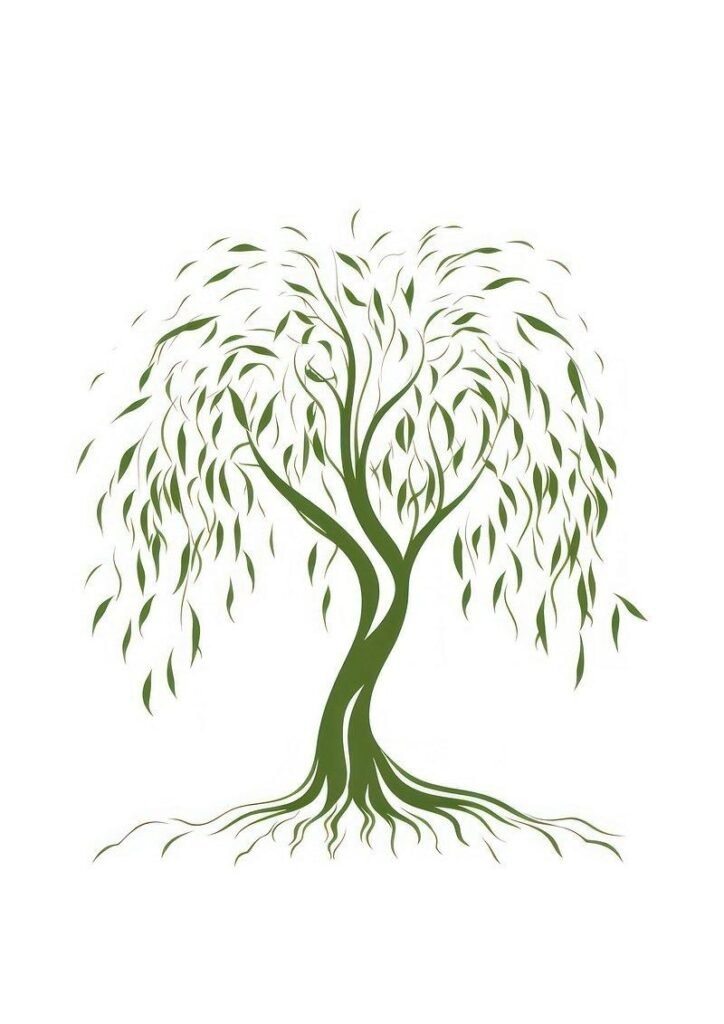
In writing and education
Teachers and writers can use the willow to explore symbolism, metaphor, cultural identity, and the relationship between the natural environment and human emotion. Comparing two works featuring willows can reveal how context changes meaning.
In design and branding
Willow branches can communicate softness, nature, reflection, or resilience. Designers should select colors, typography, and composition that support the intended message rather than relying on the tree alone.
14. Key Insights About Willow Symbolism
The most important insights about willow symbolism can be summarized through the relationship between the tree’s physical qualities and the meanings people have assigned to it.
- Resilience: Flexible branches suggest the ability to withstand pressure and adapt.
- Grief: The weeping willow has become a recognizable image of mourning and remembrance, particularly in Western memorial culture.
- Healing: The tree’s historical medicinal uses contribute to its associations with recovery, although symbolic healing and medical treatment are different things.
- Renewal: Seasonal growth and the regenerative capacity of many willow species suggest fresh beginnings.
- Spirituality: Water, intuition, reflection, and transformation appear in some spiritual interpretations, but these are not universal beliefs.
- Cultural diversity: Religious practices, folklore, literature, and local experiences shape the willow’s meanings.
- Modern relevance: Willow imagery continues to influence visual storytelling, personal expression, environmental communication, and design.
The willow’s greatest symbolic strength may be its ability to hold contrasting ideas together. It can represent sadness without hopelessness, flexibility without weakness, and change without the loss of identity.
Conclusion: Why Willow Symbolism Still Matters
Willow symbolism remains meaningful because the tree offers a vivid way to express experiences that are often difficult to put into words.
Its flowing branches, relationship with water, seasonal changes, and capacity for regeneration have inspired associations with resilience, grief, healing, wisdom, and renewal.
Throughout history, the willow has acquired different meanings through cultural traditions, religious practices, literature, folklore, medicine, and visual art.
In Western memorial imagery, it frequently represents sorrow and remembrance. In other contexts, it can suggest elegance, farewell, protection, or spiritual reflection.
In modern design and environmental communication, it can represent calmness, ecological awareness, and growth.
The key to interpreting willow symbolism is context. A tree in a poem, a religious ritual, a garden, a tattoo, and a brand identity may communicate different messages even when the same species appears in each setting.
By understanding the relationship between nature, culture, and human perception, readers can interpret symbols more thoughtfully and use them more effectively in writing, education, art, branding, and everyday communication. Ultimately, the willow reminds us that strength does not always require rigidity and that change, sorrow, and renewal can exist together.
Frequently Asked Questions About Willow Symbolism
1. What does a willow tree symbolize spiritually?
Spiritually, the willow tree is often associated with emotional healing, intuition, resilience, flexibility, and renewal. Its connection with water can suggest reflection and emotional depth, while its flexible branches represent the ability to adapt to life’s challenges. Specific spiritual meanings vary across traditions and personal belief systems.
2. Why does the willow tree symbolize sadness and grief?
The weeping willow’s long, downward-hanging branches create a visual impression of sorrow. In Western art and memorial landscapes, this appearance became associated with mourning, remembrance, and the enduring emotional effects of loss. However, willow symbolism also includes hope, renewal, and resilience.
3. What does the willow tree symbolize in different cultures?
Willow symbolism varies by cultural context. Chinese literary traditions may associate willow imagery with spring, grace, farewell, or protection in particular settings. Japanese art and folklore use willows to evoke natural beauty and sometimes supernatural themes. Western memorial culture often connects the weeping willow with grief. Specific Indigenous traditions may emphasize practical uses and community-specific cultural meanings.
4. What does a willow tree symbolize in dreams?
A willow tree in a dream may serve as a personal symbol of resilience, sadness, emotional reflection, or renewal. A healthy tree might remind the dreamer of growth, while a damaged tree might evoke vulnerability or change. There is no scientifically established universal interpretation, so personal memories and emotions are important when reflecting on a dream.
5. What does a willow tree tattoo mean?
A willow tree tattoo can symbolize resilience, healing, remembrance, emotional depth, or the ability to adapt to change. A weeping willow may honor a loved one, while a flourishing tree may represent recovery or a new beginning. Water, roots, birds, and other design elements can add personal significance.
6. Is the willow tree a symbol of strength or weakness?
The willow is generally better understood as a symbol of flexible strength rather than weakness. Its branches bend with the wind, creating a metaphor for responding to challenges instead of resisting every change. This interpretation emphasizes adaptability, endurance, and the ability to recover after difficult experiences.
Key Takeaways
- Willow symbolism commonly includes resilience, flexibility, grief, healing, renewal, and reflection.
- The weeping willow is particularly associated with mourning and remembrance in Western art and memorial traditions.
- The tree has distinct meanings in different cultural, religious, and literary contexts.
- Willow bark has a genuine medicinal history, but symbolic healing should not be confused with proven medical effects.
- In dreams, tattoos, gardens, and branding, the willow’s meaning depends on personal intention and surrounding context.
- The tree’s enduring message is that flexibility and emotional depth can coexist with strength.
Semantic SEO: Entities, NLP Concepts, LSI Keywords, and Topical Relationships
The following topic map summarizes the major semantic concepts covered in this article. These terms are useful for organizing related content, strengthening topical relevance, and planning supporting articles for a symbolism website.
Primary and Secondary Keywords
- Willow symbolism
- Willow tree symbolism
- Meaning of the willow tree
- Willow spiritual meaning
- Weeping willow symbolism
- Willow tree meaning
- Willow symbolism in different cultures
- Willow tree meaning in dreams
- Willow tattoo meaning
- Willow tree meaning in literature
- Willow symbolism in art
- Willow tree meaning in Christianity
- Willow tree meaning in Judaism
- Willow symbolism and healing
NLP Entities and Related Concepts
| Entity or concept | Relationship to willow symbolism |
| Salix | Botanical genus containing willows |
| Weeping willow | Recognizable form associated with mourning and reflection |
| Water | Habitat association and metaphor for emotional depth |
| Resilience | Adaptability and endurance |
| Renewal | Seasonal growth and regeneration |
| Grief and remembrance | Literary and memorial associations |
| Salicin | Naturally occurring compound in willow bark |
| Sukkot | Jewish festival incorporating willow branches in ritual practice |
| William Shakespeare | Literary context for willow imagery in Othello |
| Semiotics | Study of how symbols communicate meaning |
| Cultural anthropology | Study of how meanings develop within communities |
| Environmental restoration | Practical context for suitable willow species |
LSI-Style and Contextual Keywords
- Symbolic meaning of trees
- Nature symbolism
- Tree symbolism and spirituality
- Emotional healing symbols
- Symbols of hope and renewal
- Symbols of grief and remembrance
- Flexibility and inner strength
- Willow folklore and mythology
- Cultural meanings of plants
- Botanical symbolism
- Trees in poetry and literature
- Willow imagery in memorial art
- Nature-inspired branding
- Spiritual symbols associated with water
- Willow tree symbolism in modern culture
Recommended Topical Relationships for Supporting Articles
To build a connected symbolism topic cluster, consider linking this article to related subjects such as:
- Tree symbolism how trees represent life, wisdom, growth, and endurance.
- Water symbolism water as a symbol of emotions, purification, and transformation.
- Weeping willow the botanical form and its place in art and memorial landscapes.
- Flower symbolism how plants convey emotion and cultural meaning.
- Nature symbolism how landscapes, animals, plants, and natural processes become symbols.
For SEO, use these related topics where they genuinely help readers navigate between relevant articles. Prioritize accurate explanations, meaningful internal links, and distinct search intent over repeating keywords. No article can guarantee rankings or AI-search visibility, but a well-researched, clearly structured, reader-focused page provides a strong foundation for organic search performance.

Learn about religious symbolism, cultural icons, and historical meanings with William Carter.
