
Introduction: Why Purple Color Symbolism Matters
Purple color symbolism connects one of the most visually distinctive colors with ideas of royalty, wisdom, spirituality, creativity, luxury, and mystery.
From royal garments and religious artwork to modern branding, fashion, and interior design, purple has long been used to communicate qualities that words alone may struggle to express.
Understanding its symbolism reveals how color influences cultural identity, emotional associations, storytelling, and everyday communication.
Purple occupies an intriguing place between red and blue on the traditional artist’s color wheel.
Red is often associated with energy and passion, while blue commonly suggests calmness, stability, and trust.
Purple can evoke aspects of both, although its precise meaning depends on its shade, setting, and cultural context.
The symbolism of purple is particularly fascinating because its historical associations with wealth and authority developed partly from the difficulty and expense of producing certain purple dyes.
Over time, these associations expanded into spiritual traditions, artistic expression, psychological interpretation, and contemporary visual communication.
Whether you are researching color symbolism, exploring the spiritual meaning of purple, choosing a brand palette, or interpreting purple in a dream, understanding the context behind the color helps you avoid simplistic assumptions.
What Does the Color Purple Symbolize?
Purple commonly symbolizes royalty, luxury, wisdom, spirituality, imagination, creativity, mystery, and transformation. Historically associated with expensive dyes and elite status, it became a visual marker of authority and prestige. Today, purple can communicate elegance, individuality, introspection, or innovation, although its meaning varies across cultures, shades, personal experiences, and situations.
1. The Core Meanings of Purple
Purple is a versatile symbolic color because it can suggest prestige and imagination at the same time. Its meaning shifts according to the shade, the surrounding colors, and the message being communicated.
Royalty, wealth, and authority
Deep purple is strongly associated with monarchs, ceremonial clothing, prestige, and exclusivity. This meaning is rooted in the historical cost of producing certain purple dyes.
Wisdom and spiritual reflection
Purple is often used to represent contemplation, sacred knowledge, inner awareness, and the search for meaning. These associations are prominent in various spiritual and contemporary esoteric traditions.
Creativity and imagination
Purple appears in artistic environments and creative branding because it can convey originality, experimentation, and a sense of possibility.

Mystery and transformation
Twilight, shadows, and deep violet tones can evoke the unknown, introspection, and change. Writers and artists often use purple to create an atmosphere of uncertainty or enchantment.
These meanings are common associations rather than universal rules. A purple garment may suggest luxury in one setting and personal expression in another. Likewise, purple used in a religious ceremony can carry a specific meaning that differs from its role in commercial advertising.
2. The History and Origins of Purple Color Symbolism
Purple’s historical symbolism developed through the relationship between natural materials, trade, political authority, and social status. In several ancient societies, particular purple dyes were difficult to manufacture, making purple textiles costly and desirable.
Ancient Phoenicia and Tyrian purple
11
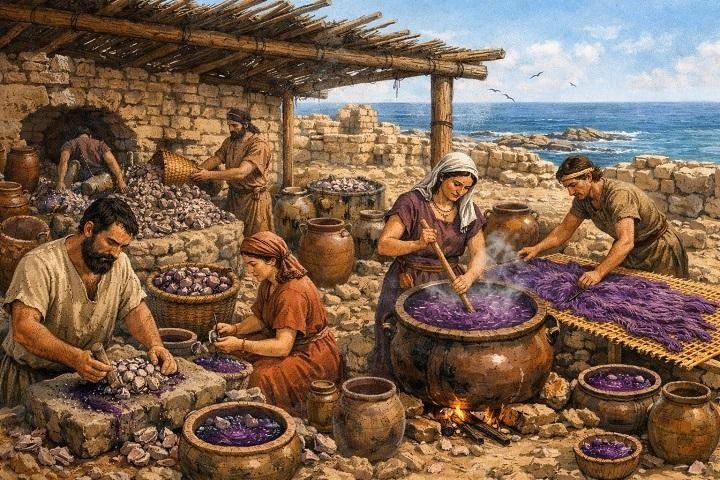
One of the most influential examples is Tyrian purple, a dye associated with the ancient Mediterranean city of Tyre and other Phoenician dye-producing centers. It was made from secretions of certain marine mollusks, including murex sea snails. Producing the dye required substantial labor and large numbers of shellfish.
The University of Chicago Library
+1
Because this dye was expensive, purple textiles became associated with wealth, influence, and elite status. The color’s meaning therefore arose partly from economic circumstances rather than from an inherent psychological property.
Purple in ancient Rome
In ancient Rome, purple became a visible marker of political and social rank. Particular purple garments and decorative bands were associated with offices and privileged groups, while imperial purple acquired especially strong connections with the emperor.
The phrase born to the purple, associated with Byzantine imperial life, eventually came to describe someone born into exceptional privilege or authority.
The history demonstrates an important principle of semiotics: a color becomes a social symbol when people repeatedly connect it with particular institutions, practices, and expectations. Purple’s prestige was reinforced by laws regulating clothing, elite ceremonies, and representations of authority.
Wiley Online Library
+1
The transformation of purple in the modern era
For centuries, obtaining rich purple dyes remained difficult. The development of synthetic dyes in the nineteenth century changed the situation, making purple shades more accessible to clothing manufacturers, artists, and ordinary consumers.
William Henry Perkin’s discovery of mauveine in 1856 helped launch the modern synthetic dye industry. Purple could now circulate more widely in fashion and popular culture rather than remaining primarily a marker of wealth.
Its symbolism expanded accordingly. Royalty and luxury remained important associations, but purple also became a color of fashion, artistic individuality, popular entertainment, and personal identity.
Key historical insight: Purple did not become prestigious simply because people found it beautiful. Material scarcity, commercial production, political institutions, and cultural storytelling all helped establish its symbolic value.
3. Purple Color Psychology: What Does Purple Make People Feel?
Purple color psychology examines the associations people develop with purple and how those associations may influence perception, emotion, and judgment.
Purple is frequently linked with power, imagination, prestige, and mystery. However, psychology does not establish that everyone responds to purple in the same way or that the color automatically produces a particular emotion.
A 2025 systematic review of color–emotion research examined 132 relevant studies involving 42,266 participants from 64 countries. It found systematic relationships between colors and emotional associations, while also showing that these relationships depend on several factors, including hue, lightness, and saturation. Purple was associated with empowering emotions in the review.
Springer Nature Link
+1
Why purple can feel luxurious
Dark, saturated purple is frequently used in settings that aim to communicate exclusivity. Its historical relationship with expensive textiles gives it an established cultural association with wealth and prestige.
For example, a dark purple product box paired with restrained typography and metallic accents may look more formal or premium than a brightly colored package with playful graphics.
However, the effect depends on the complete design. Material quality, typography, lighting, price, and brand reputation all contribute to the impression.
Why purple can suggest creativity
Purple is also associated with originality and unconventional thinking. Because it is less routinely used than some colors in everyday institutional settings, it can help a design appear distinctive.
A creative studio might use violet in its visual identity to communicate imagination, while a technology company might use a brighter purple to suggest experimentation and modernity.
This does not mean purple automatically makes people more creative. It means the color can participate in a visual language that communicates creativity.
Why purple can feel mysterious
Deep violet, indigo-like purples, and purple-black combinations often appear in depictions of night skies, fantasy worlds, magic, and the supernatural.
These associations arise partly from artistic convention. When filmmakers repeatedly use purple lighting to represent an unfamiliar world or an extraordinary event, audiences learn to recognize that visual cue.
Purple’s psychological meaning at a glance
| Association | Possible interpretation | Important qualification |
| Luxury | Quality, exclusivity, prestige | Depends on design and context |
| Wisdom | Reflection, experience, insight | Often a cultural or spiritual association |
| Creativity | Originality, imagination | Does not prove improved creative ability |
| Mystery | The unknown, fantasy, secrecy | Often shaped by storytelling |
| Calm | Softness, gentleness, reflection | Pale purple may feel different from saturated violet |
| Power | Authority, confidence, influence | Historical and cultural context matters |
Expert tip: When interpreting purple, consider its brightness, saturation, neighboring colors, and purpose before assigning a meaning. A pale lavender room and a deep purple royal robe do not necessarily communicate the same message.
4. Spiritual Meaning of Purple
Purple is widely used in spiritual symbolism to represent contemplation, wisdom, transformation, and a connection with the sacred. These meanings are especially visible in contemporary spiritual practices, devotional imagery, and traditions that use color in ritual.
However, spiritual interpretations are belief-based frameworks, not universally established scientific facts. Their significance depends on the particular tradition and the individual interpreting the color.
Purple and spiritual awareness
In some contemporary spiritual and esoteric systems, purple represents a movement beyond ordinary concerns toward deeper reflection or awareness. Amethyst crystals, violet candles, and purple fabrics may be used as visual reminders of meditation, intuition, or personal development.
Within these settings, purple may symbolize:
- Seeking wisdom beyond surface appearances.
- Making time for reflection and meditation.
- Exploring intuition and personal meaning.
- Moving through periods of change.
- Balancing worldly ambition with inner life.
These are possible interpretations, not guaranteed effects. A purple object does not independently establish spiritual insight or produce a particular supernatural outcome.
Purple and the crown chakra
In some modern chakra-based spiritual systems, violet or purple is associated with the crown chakra, located symbolically at the top of the head. The crown chakra is commonly linked with spiritual awareness, transcendence, and a sense of connection with something greater than the individual self.
The exact color associations vary among teachers and contemporary traditions; some systems use white rather than purple for this energy center.
Chakras belong to religious and spiritual frameworks with their own histories. They should not be presented as scientifically verified anatomical structures.
Purple as a symbol of transformation
Purple’s association with transformation can be understood through its use in rituals, art, and personal narratives. It may appear during a story’s transition from confusion to understanding or from an old identity to a new one.
For example, someone beginning a meditation practice might choose a purple journal to represent introspection. The notebook’s importance comes from the intention attached to it, not from a universal property of the color.
5. Purple in Religion and Religious Symbolism
Religious meanings of purple differ across traditions, denominations, periods, and ritual settings. Its history in Christianity is particularly well documented, but it is important not to assume that every religion uses purple in the same way.
Purple in Christianity
In many Western Christian traditions, violet or purple is used during Advent and Lent. These liturgical seasons involve preparation, reflection, and, particularly during Lent, penitence.
Purple also appears in biblical accounts of royal clothing and in descriptions of Jesus being dressed in a purple or scarlet robe during the Passion narratives, depending on the Gospel passage and translation. Christian interpretations can connect these garments with kingship, suffering, humiliation, and the contrast between worldly authority and spiritual meaning.
npj Heritage Science
+1
The color’s precise use in church services varies by denomination and liturgical custom. Purple is not the universal color for every Christian ceremony.
Purple in Judaism and the ancient Near East
Purple-dyed textiles had significance in parts of the ancient Near East, including societies whose material culture informs the historical context of biblical references to fine fabrics and prestigious clothing.
In biblical descriptions, purple can appear alongside other valuable materials. Such references may communicate wealth, rank, craftsmanship, or ceremonial importance.
Interpretation requires attention to the specific passage, its original language, and the historical setting. It would be misleading to assign one fixed spiritual meaning to every reference to purple in Jewish history or religious practice.
Purple in other religious and cultural settings
Purple may appear in Buddhist art, Hindu devotional imagery, contemporary spiritual practices, and other religious or ceremonial environments. Its significance, however, cannot be reduced to a single shared doctrine.
In some contexts, purple may communicate dignity or devotion; in others, it may simply be an artistic choice or a feature of a particular regional tradition.
Myth vs. fact
| Claim | More accurate explanation |
| Purple means spirituality in every religion. | Its religious meaning depends on the specific tradition and context. |
| Purple has one official biblical meaning. | Its meaning varies across passages, historical settings, and interpretations. |
| Wearing purple makes a person spiritually enlightened. | Clothing can express beliefs or intentions but does not prove spiritual attainment. |
| Every purple religious garment has the same significance. | Different garments, offices, and rituals may use purple for different reasons. |
6. Purple Color Symbolism Across Cultures
Purple has no single meaning shared equally by all cultures. Its associations are shaped by local histories, religious practices, language, social hierarchies, and the availability of dyes and pigments.
Ancient Mediterranean and European traditions
Purple became associated with royalty, wealth, and elite status through costly dyes, imperial clothing, and ceremonial use. In later European traditions, it also developed associations with religious reflection and artistic sophistication.
Japan
Purple has historical associations with aristocratic status and high rank. These meanings developed within particular social and political systems, rather than from a universal property of the color.
China
Purple has appeared in traditional cosmological and imperial contexts, including associations with celestial authority. Its significance depends on the particular historical period, symbolic system, and shade.
Western contemporary culture
Purple can suggest luxury, creativity, individuality, mystery, or spirituality. It also appears in entertainment, fashion, marketing, and social movements, where its meaning depends on the organization or community using it.
Research supports the importance of cultural context in color interpretation. A cross-cultural investigation of color associations found both recurring conceptual patterns and culture-specific differences. Research focused specifically on purple, violet, and lilac across 30 populations also found that the language used to name a color could influence its emotional associations.
PubMed
+1
These findings are a useful reminder that even apparently simple color categories are not always experienced identically.
Cultural interpretation comparison
| Context | Commonly documented association | Interpretive caution |
| Ancient Rome | Imperial power and rank | Not every Roman used or understood purple identically |
| Byzantine imperial tradition | Royal and imperial authority | Specific shades and garments mattered |
| Western Christianity | Advent, Lent, penitence, reflection | Liturgical customs differ |
| Japanese historical culture | Aristocratic status and rank | Meaning changed across periods |
| Contemporary design | Luxury, originality, distinction | Audience and product category affect perception |
| Modern spiritual practices | Intuition, contemplation, transformation | These are tradition-based beliefs, not universal facts |
Did you know? The phrase royal purple is not merely a poetic description. Certain purple dyes were historically so costly that their production and use became intertwined with social privilege and political authority.
The University of Chicago Library
+1
7. The Meaning of Different Shades of Purple
Not every purple communicates the same idea. Hue, saturation, brightness, surrounding colors, and material finish can all change the impression.
Royal purple
Deep, rich, and saturated
Associated with prestige, authority, elegance, and luxury. Often suitable for premium packaging, formal invitations, and sophisticated visual identities.
Violet
Vivid and expressive
Often used to suggest imagination, spirituality, fantasy, or creative energy. The word violet also has a more specific meaning in color science than the broad everyday category purple.
Lavender
Light, muted, and gentle
Commonly associated with softness, relaxation, romance, and refinement. Its floral associations also influence how people interpret it.
Lilac
Pale, floral, and delicate
Often suggests freshness, tenderness, youthfulness, or nostalgia. These associations are common in contemporary design rather than universal symbolic rules.
Dark purple
Deep and dramatic
Can suggest mystery, seriousness, luxury, introspection, or melancholy. Its effect depends strongly on lighting and surrounding colors.
Purple versus violet: Are they the same?
In everyday language, purple and violet are often used interchangeably. In more technical contexts, violet refers to a region of the visible spectrum, while many purples are perceived through combinations of red and blue light that are not single spectral wavelengths.
This distinction matters in digital design, printing, and discussions of color perception. A purple swatch on a screen may also look different when printed because displays and printing systems reproduce colors through different processes.
8. Purple Symbolism in Art, Literature, and Storytelling
Artists and writers use purple to communicate ideas that may be difficult to express directly. Depending on the work, it can suggest grandeur, temptation, grief, imagination, transformation, or the unfamiliar.
Purple in visual art
11
Purple has played an important role in painting, decorative arts, textiles, and illustration. Its expressive potential expanded as pigments and dyes became more accessible and reliable.
Impressionist and Post-Impressionist artists explored violet and purple tones to depict shadows, atmospheric effects, and changing light. Instead of treating shadows as uniformly black or gray, some artists used colored shadows to create greater visual complexity.
In modern art, purple may establish contrast, intensify emotion, or create an otherworldly atmosphere. Its meaning depends on the artwork’s composition and historical context.
Purple in literature
In literature, purple can function as a symbolic shorthand for status, imagination, emotional intensity, or excess.
The expression purple prose illustrates the more critical side of its symbolism. It describes writing that is excessively ornate or elaborate, drawing attention to its language rather than serving the story. The expression reflects a long-standing literary association between purple and conspicuous display.
A writer might describe a purple sky to suggest a transition between day and night, a dreamlike mood, or a world that feels unfamiliar. But the same color could represent a royal setting or a character’s distinctive personality.
Purple in film and popular culture
Filmmakers frequently use purple lighting, costumes, and visual effects to differentiate fantasy worlds, communicate atmosphere, or establish a character’s identity.
Music and entertainment have also given purple new associations. Prince’s Purple Rain, for example, helped make the color a recognizable element of his artistic identity, while the novel The Color Purple by Alice Walker uses its title within a larger exploration of dignity, beauty, and human experience.
AP News
These examples demonstrate that symbolism evolves through cultural works. A color may acquire a meaning through one influential story and then be reinterpreted by later audiences.
9. Purple in Branding, Marketing, and Business
Purple color symbolism is useful in branding because color can help an organization establish a recognizable identity and communicate a desired impression before a customer reads its message.
Brands may choose purple to suggest creativity, premium quality, individuality, imagination, or a distinctive personality. Yet color alone cannot guarantee trust, sales, or customer loyalty.
Why brands choose purple
- Premium positioning: Deep purple can support a sophisticated, luxurious visual identity.
- Creative differentiation: Bright violet can help a brand appear imaginative or unconventional.
- Beauty and personal care: Lavender and lilac can convey softness, elegance, or floral associations.
- Technology and entertainment: Saturated purple may suggest innovation, fantasy, or digital creativity.
- Lifestyle products: Purple can help communicate individuality, self-expression, or a distinctive aesthetic.
Practical branding example
Imagine two businesses selling handmade skincare products.
The first uses dark purple packaging, minimal typography, and metallic detailing. The overall design may suggest luxury and exclusivity.
The second uses pale lavender, botanical illustrations, and soft typography. The same broad color family may now suggest gentleness, floral ingredients, and a calming experience.
The difference does not come from purple alone. It comes from the interaction of color, imagery, typography, materials, price, and audience expectations.
Expert tip: Before selecting purple for a brand, define the desired impression in plain language. Then test the color palette with representative customers rather than assuming that everyone associates purple with luxury or creativity.
10. Practical Applications of Purple Color Symbolism
Understanding purple symbolism can help with more than artistic interpretation. It can guide everyday design decisions, educational activities, visual storytelling, and personal expression.
| Application | Possible use of purple | What to consider |
| Interior design | Create a dramatic, elegant, or reflective atmosphere | Room size, natural light, and saturation |
| Fashion | Communicate individuality, formality, or luxury | Fabric, cut, occasion, and cultural setting |
| Education | Highlight creative projects or organize visual information | Consistency and readability |
| Website design | Establish a distinctive brand identity | Contrast, accessibility, and audience expectations |
| Packaging | Signal a premium or imaginative product identity | Competitors and customer research |
| Storytelling | Suggest transformation, mystery, or authority | Character, plot, and narrative context |
| Personal expression | Represent a chosen mood or identity | Individual associations and preferences |
Purple in interior design
Pale lavender can be used in bedrooms or reading areas when a gentle visual atmosphere is desired. Deep purple can create a more dramatic effect in an accent wall, upholstered chair, or decorative feature.
Lighting is crucial. A purple that appears soft in daylight may look much darker under warm artificial light.
Purple in website and digital design
For a website, purple can help establish a memorable identity, but it should not compromise readability.
Use sufficient contrast between text and background, maintain consistent color roles, and test the design on different screens. Color should never be the only way of communicating essential information; labels, icons, and text can make the interface more accessible.
Purple in education and communication
Teachers can use color-coded materials to organize categories, distinguish concepts, or make diagrams easier to navigate. Purple may be assigned to a category as a design choice, but learners should be told what the color represents rather than expected to infer a universal meaning.
Common mistakes when interpreting purple
- Assuming purple always means royalty. Its prestige associations are historically important, but modern uses extend far beyond monarchy.
- Treating spirituality as a scientific effect. Spiritual interpretations can be meaningful within a tradition without being empirically established.
- Ignoring shade differences. Lavender, violet, and dark purple may create quite different visual impressions.
- Assuming one cultural interpretation applies everywhere. Historical and regional context can substantially change a color’s meaning.
- Using purple without considering accessibility. Attractive colors still need sufficient contrast and clear visual hierarchy.
- Believing color alone determines behavior. Consumer decisions depend on product quality, experience, price, culture, and many other factors.
11. Purple in Philosophy and Human Identity
Purple offers a useful example of how human beings create meaning through material objects and shared conventions. A color has physical properties, but its symbolic significance develops through the ways people use, discuss, remember, and interpret it.
From a philosophical perspective, purple raises an important question: does a symbol contain meaning inherently, or do people give it meaning?
The history of royal purple suggests that both physical experience and cultural interpretation matter. The dye’s rarity was a material reality; its association with political authority developed through institutions, customs, and repeated social practices. Scholars studying the history of color have examined precisely this relationship between color, language, law, and social power.
Wiley Online Library
+1
This perspective also explains why purple can communicate different ideas to different people. Someone may associate it with a family tradition, a favorite flower, a religious ceremony, a musical artist, or an important personal experience.
In other words, color symbolism is not merely a dictionary of fixed meanings. It is an evolving system of visual communication shaped by culture, memory, and context.
12. Key Insights: Understanding Purple Color Symbolism
The most useful way to interpret purple is to consider its major associations alongside the circumstances in which they developed.
- Royalty and luxury: These associations have strong historical roots in the expense and prestige of certain purple dyes.
- Wisdom and spirituality: Purple often appears in religious, contemplative, and contemporary spiritual settings, although interpretations differ.
- Creativity and imagination: Art, entertainment, and branding use purple to communicate originality and distinctive expression.
- Mystery and transformation: Purple can establish a dreamlike, dramatic, or unfamiliar atmosphere in visual storytelling.
- Cultural identity: Different societies and historical periods have assigned purple different social, ceremonial, and religious meanings.
- Psychological associations: Research identifies relationships between color and emotion, but these are influenced by shade, language, context, and individual experience.
- Practical communication: Designers can use purple strategically when its associations support the intended message and audience.
Purple’s strength as a symbol lies in its flexibility. It can suggest privilege and individuality, introspection and theatricality, tradition and innovation. Understanding these possibilities makes it easier to interpret the color thoughtfully rather than relying on simplistic claims.
Conclusion: Why Purple Color Symbolism Still Matters
purple color symbolism has evolved from the prestige of ancient dyes into a rich language of cultural, emotional, artistic, and social expression.
Its historical association with royalty and wealth remains influential, while its contemporary meanings extend to creativity, spirituality, imagination, mystery, and personal identity.
Its significance becomes clearer when history, psychology, religion, and visual communication are considered together.
Purple does not possess one permanent meaning, nor does it produce identical emotional responses in everyone. Its interpretation depends on the shade, cultural background, surrounding imagery, and purpose for which it is used.
Whether purple appears in a religious ceremony, a painting, a novel, a website, or a product package, understanding its symbolic possibilities can improve communication and deepen interpretation.
The color continues to matter because people continually adapt familiar visual symbols to express new ideas.
Frequently Asked Questions About Purple Color Symbolism
1. What is the main symbolic meaning of purple?
Purple most commonly symbolizes royalty, luxury, wisdom, spirituality, creativity, and mystery. Its association with royalty has strong historical roots in the high cost of certain ancient purple dyes. In modern contexts, purple can also represent individuality, imagination, and transformation. The intended meaning depends on the shade, culture, and situation.
2. What does purple mean spiritually?
In some spiritual traditions, purple represents inner awareness, wisdom, contemplation, and transformation. Contemporary chakra-based practices often associate violet or purple with the crown chakra and spiritual awareness. These interpretations belong to particular belief systems and are not universal scientific findings.
3. Why is purple associated with royalty?
Purple became associated with royalty because certain historical dyes, particularly Tyrian purple, were difficult and expensive to produce. Elite groups and rulers used purple textiles to display wealth and rank. In ancient Rome and later Byzantine traditions, particular purple garments became closely connected with imperial authority.
4. What does wearing purple symbolize?
Wearing purple may communicate confidence, elegance, creativity, individuality, or a sense of prestige. In some religious and ceremonial contexts, it may have a more specific meaning. However, clothing does not have a universal symbolic message; its interpretation depends on the occasion, culture, garment, and personal intention.
5. What is the difference between purple and violet symbolism?
Purple and violet often share associations with royalty, spirituality, imagination, and mystery. In everyday language, their meanings overlap considerably. Violet can have a more specific technical meaning in color science, while purple commonly describes a broader range of reddish-blue hues. Their symbolic associations depend on cultural conventions and the particular shade.
6. Is purple a positive or negative color?
Purple can have positive or negative associations depending on its context. It may suggest creativity, luxury, dignity, and wisdom, but it can also evoke extravagance, melancholy, secrecy, or excess. Neither interpretation is universally correct. The surrounding colors, cultural expectations, and intended message influence how purple is understood.
Final Key Takeaways
- Purple is a historically significant symbol of royalty, prestige, and authority.
- Spirituality, wisdom, creativity, mystery, and transformation are other common associations.
- Different shades, from lavender to deep royal purple, can communicate different impressions.
- Religious and cultural interpretations must be understood within their specific traditions.
- Color psychology identifies associations rather than guaranteeing emotional or behavioral outcomes.
- Purple can support effective branding, storytelling, fashion, interior design, and digital communication when used intentionally.
Semantic Entities, NLP Concepts, and Related Keywords
The following topical terms and relationships are naturally covered in this article and can help organize related content on a symbolism website.
| Category | Related entities and concepts |
| Primary keyword | Purple color symbolism, purple symbolism, meaning of purple |
| Color terminology | Purple, violet, lavender, lilac, royal purple, dark purple |
| Historical entities | Tyrian purple, Phoenicia, Tyre, ancient Rome, Byzantine Empire, William Henry Perkin, mauveine |
| Symbolic meanings | Royalty, luxury, prestige, wisdom, spirituality, creativity, mystery, transformation, authority |
| Psychology and perception | Color psychology, emotion associations, hue, saturation, brightness, human perception, cultural learning |
| Religious and spiritual concepts | Christianity, Advent, Lent, crown chakra, meditation, sacred imagery, devotional symbolism |
| Cultural studies | Anthropology, cultural identity, semiotics, iconography, mythology, symbolism, social status |
| Art and communication | Visual communication, painting, literature, film, storytelling, fashion, architecture, digital media |
| SEO topic cluster | Purple color meaning, spiritual meaning of purple, purple psychology, purple in history, purple in different cultures, purple in branding |
| Practical applications | Brand identity, color palettes, packaging design, interior design, accessibility, visual hierarchy, consumer perception |
Suggested related articles for a symbolism topic cluster:
- The Symbolism of Violet
- Lavender Color Meaning and Symbolism
- Blue Color Symbolism
- Red Color Symbolism
- Black Color Symbolism
- The Psychology of Color in Branding
- Color Symbolism Across Cultures
- The Spiritual Meaning of Purple in Different Traditions
These topics can be linked naturally where they help readers explore a related question. No article structure or keyword list can guarantee a particular search ranking, but accurate, well-organized, distinctive content provides a stronger foundation for long-term search visibility.

Explore mythology, ancient symbols, and historical meanings with Benjamin Foster.
